
Lions Clubs International (LCI) is the largest service club organization in the world, comprising approximately 1.4 million members operating within more than 48,000 individual clubs across over 200 countries and geographic areas. From its roots in early twentieth-century American civic life, the association evolved into a decentralized, grassroots humanitarian network capable of responding to immediate local community needs while orchestrating multimillion-dollar global health campaigns. Unlike traditional charitable foundations that rely primarily on direct endowment grants or professional field workers, Lions Clubs International operates through local volunteer civic bodies. The clubs function autonomously to support community projects while contributing resources to coordinated international initiatives focused on vision conservation, hunger relief, environmental protection, childhood cancer, and diabetes prevention.
Melvin Jones and the 1917 Founding
The creation of Lions Clubs International began with Melvin Jones, a Chicago insurance executive and secretary of the Business Circle of Chicago. In the early decades of the twentieth century, American business clubs served almost exclusively as networking hubs designed to advance the commercial and financial interests of their members.Jones questioned whether this collective commercial influence could be redirected toward unselfish public service. He challenged his fellow businessmen with a simple question: what would happen if people applied their drive and abilities toward improving their communities?Acting on this concept, Jones contacted independent business and civic clubs across the United States. On June 7, 1917, representatives from various groups convened at the Hotel La Salle in Chicago, Illinois. From this meeting emerged the Association of Lions Clubs. The name "Lions" was selected from among the participating delegations, specifically an established association in Texas led by Dr. William P. Woods of Indiana, who was elected the organization's first president. Jones assumed the post of acting secretary, beginning a lifelong career guiding the organization's growth.In October 1917, the newly formed association held its first national convention in Dallas, Texas. The delegates drafted and ratified a formal constitution, bylaws, a code of ethics, and an underlying principle that has remained central to the organization's charter: no club shall hold out the financial betterment of its members as an objective. This formal prohibition separated the Lions from commercial trade groups and established civic philanthropy as its sole purpose.
Helen Keller and the Sight Mission (1925)
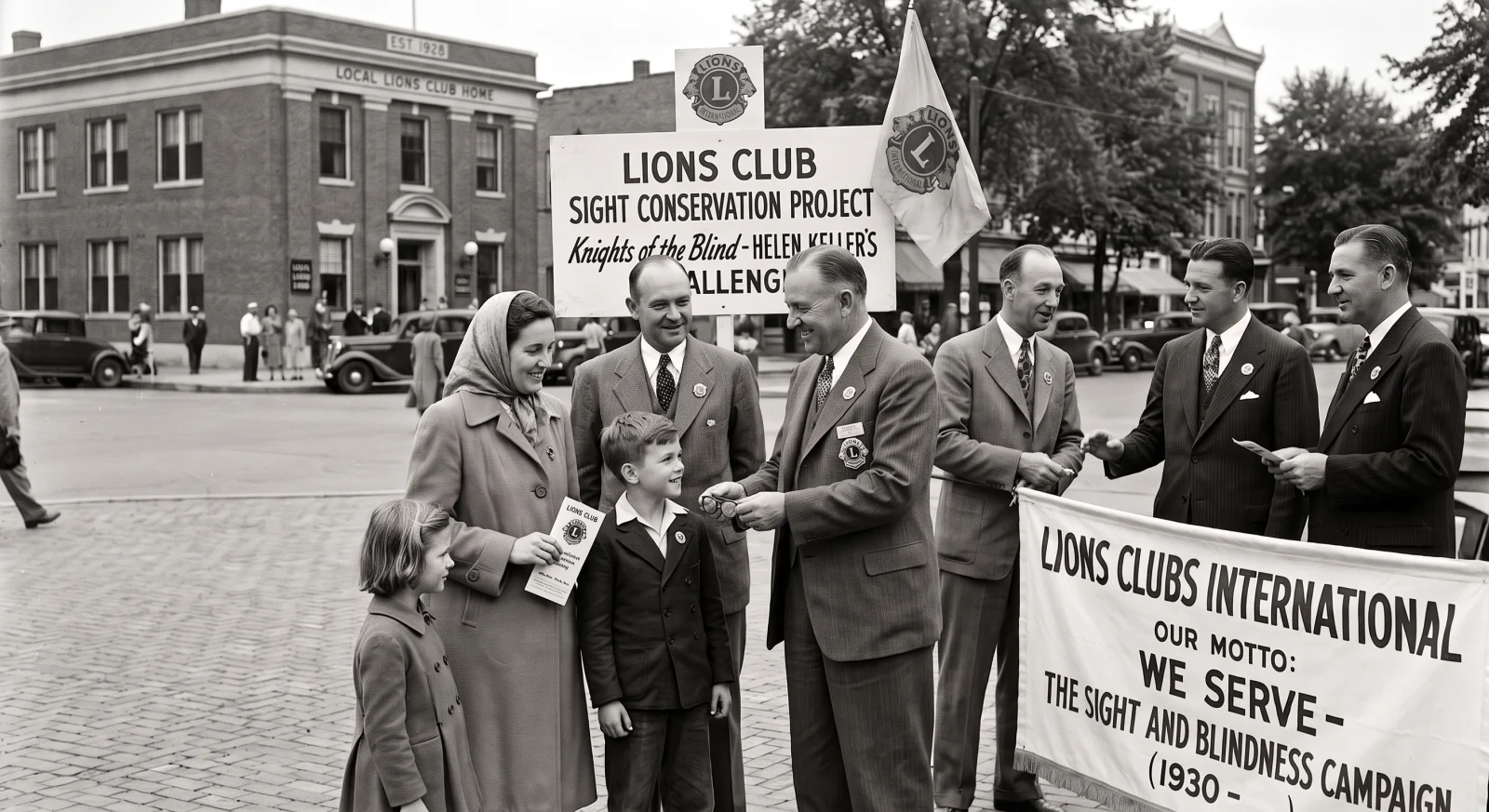
During its initial years, local Lions clubs engaged in broad civic betterment campaigns, including public health education, support for orphanages, sanitation improvements, and park construction. However, the organization gained its defining international mission in 1925 at the International Convention held in Cedar Point, Ohio. Helen Keller addressed the convention alongside her teacher, Anne Sullivan. Keller called upon the delegates to use their civic influence to support blind individuals and eliminate preventable vision loss. She asked the assembly to become "knights of the blind in the crusade against darkness," framing the challenge as an opportunity to turn collective strength into lifelong sight advocacy. This presentation shifted the primary humanitarian focus of the association. In response to Keller's appeal, Lions Clubs adopted sight preservation and assistance to the blind as their signature global cause. The initiative led directly to:
The White Cane Movement: In 1930, George A. Bonham, president of the Lions Club of Peoria, Illinois, observed a blind pedestrian struggling to cross a busy street. Recognizing that black walking sticks were invisible to motorists, Bonham advocated painting white canes with a red band for blind pedestrians, a safety standard Lions subsequently campaigned for and popularized across the globe.
Eye Banks and Clinical Facilities: Lions established and financed clinical eye banks, providing donor tissue for corneal transplants and helping construct specialized ophthalmological hospitals in underserved areas.
Eyeglass Recycling: Clubs launched regional collection networks to sort, clean, and categorize used prescription eyeglasses, sending millions of pairs annually to developing countries.
Early Screening: Comprehensive vision screenings were introduced into primary schools to diagnose amblyopia and refractive errors in young children before permanent vision loss occurred.
International Expansion and UN Involvement (1920–1950s)
The organization broadened beyond the United States in 1920 with the chartering of the Border Cities Lions Club in Windsor, Ontario, Canada, prompting the formal adoption of "Lions Clubs International" as the association's title. Growth into Mexico followed in 1927, establishing an early hemispheric presence.
Post-World War II reconstruction accelerated international expansion into Europe, Asia, and Latin America during the late 1940s and 1950s. Clubs were established across Sweden, Switzerland, France, and Japan, establishing the Lions as a cross-cultural humanitarian organization.